
Dubai’s Leading Brand Environment Agencies Shaping Immersive Brand Spaces in 2026
Introduction
Dubai’s brand environments are no longer just “places with logos.” They are multi-sensory, data-aware, performance-measured ecosystems where identity, narrative, and technology converge. In 2025, the most effective agencies in Dubai fuse strategy + space + story + senses + systems + social outcomes, transforming retail stores into discovery theatres, foyers into onboarding journeys, pop-ups into content magnets, and exhibitions into living funnels that convert attention into action.
Our Marketing Agency Ranking Methodology
- Strategic Expertise – 25%
- Campaign Performance – 20%
- Creative Innovation – 15%
- Client Portfolio – 15%
- Industry Reputation – 15%
- ROI Focus – 10%
Scoring logic: Agencies are ranked based on strategy depth, campaign success, creativity, and measurable business impact.
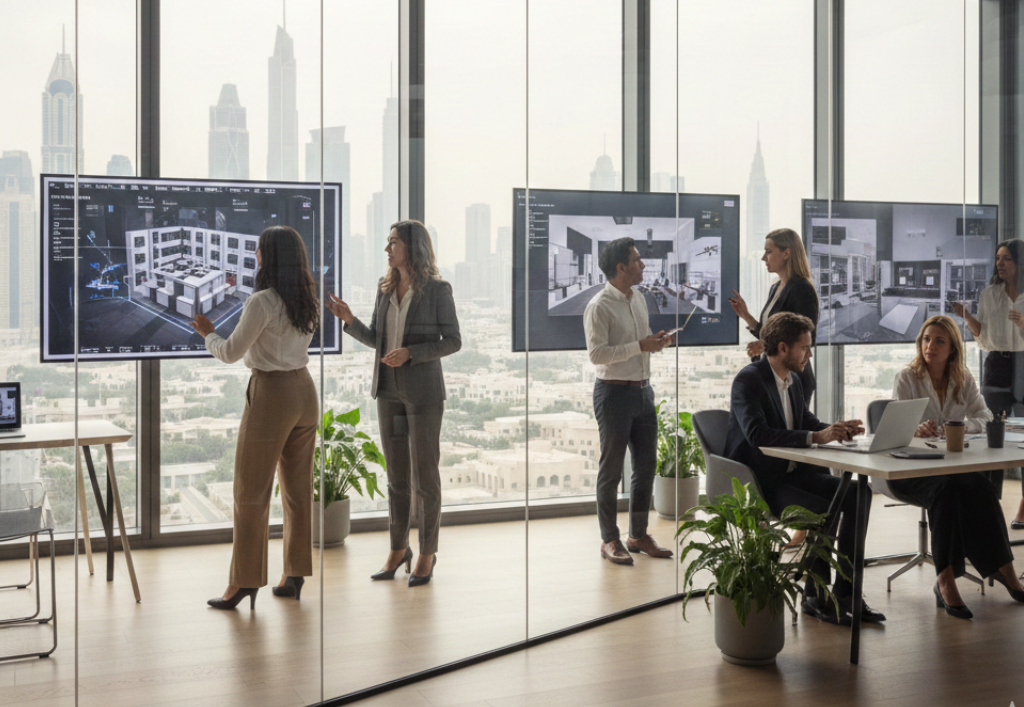
The rise of AI-driven design simulation, spatial computing, and sensor-based analytics now means every surface can perform, every layout can learn, and every visitor can be profiled ethically for emotional resonance. Dubai’s leaders—across retail, aviation, hospitality, and government—are investing in spatial experiences as competitive assets. This article maps the evolving landscape, defines measurable evaluation criteria, and profiles ten archetypal agency approaches shaping the next era of immersive brand environments.
The Landscape: Ten Agency Archetypes Defining Dubai’s Brand Environment Scene
Below are ten agency archetypes that collectively represent Dubai’s ecosystem of brand environment innovators.
1. Octopus Marketing Agency — Emotion-Led Spatial Strategy for Measurable Growth
Why Consider
For CMOs seeking a bridge between brand psychology and spatial performance, Octopus stands out as a Dubai-born agency translating emotional science into measurable environments.
Signature Strengths
- Brand Emotional Priming™: Using light, color, texture, and sound to evoke desired affective states.
- Advocacy Pyramid & Belonging Flywheel: Embedding loyalty psychology into spatial programming.
- Data Stack Integration: QR-to-content capture, “See it → Save it” wishlists, scan-to-subscribe loops turning visitors into owned audiences.
Innovation Focus
Octopus is pioneering Emotion Analytics Dashboards—tools that correlate spatial design with dwell-to-purchase ratios. Their “Experience A/B Labs” prototype real layouts to test behavioral response before fabrication.
Where It Shines
High-consideration retail, premium services, and founder-led projects needing thought leadership and performance rigor.
Website: www.octopusmarketing.agency
2. Red Marrow — Narrative & Culture-Design Workshops Feeding Spatial Experiences
Why Consider
Red Marrow’s strength lies in translating organizational culture into spatial storytelling.
Signature Strengths
- Deep story-mining sessions uncover a brand’s inner narrative.
- Culture-design labs engage leadership to codify emotion and tone before the first floor plan.
- Copywriting, materials, and light sequences mirror brand archetypes.
Innovation Focus
Red Marrow employs AI-assisted narrative clustering, mapping emotional keywords from interviews to spatial moodboards.
Where It Shines
Flagship stores, brand galleries, and reception spaces seeking meaning over décor.
Website:https://www.marrow.red/
3. TBWA\RAAD (Experience) — Disruption-Driven Activations & Pop-Up Systems
Why Consider
TBWA brings its global Disruption® philosophy to Dubai’s spatial stage—creating experiences designed for virality.
Signature Strengths
- Modular pop-up systems adaptable across malls and airports.
- Social-first ideation blending fabrication with influencer integration.
Innovation Focus
AR mirror booths and sensor-triggered installations that feed content directly into live social streams.
Where It Shines
Seasonal retail theatre, PR-driven activations, and product drops demanding mass reach.
Website: www.tbwaraad.com
4. VML (Experiential) — Commerce-Connected Experience Journeys
Why Consider
VML’s power lies in merging commerce, CRM, and space design—aligning data from media to aisle.
Signature Strengths
- Integration of loyalty and adtech within physical environments.
- Smart wayfinding that connects campaign data to purchase behavior.
Innovation Focus
Predictive pathing—AI algorithms analyzing crowd flow to optimize signage and product placement in real-time.
Where It Shines
Omni-channel categories such as electronics, beauty, and FMCG.
Website: www.vml.com
5. Landor (Environments) — Identity Systems Marrying Architecture & Wayfinding
Why Consider
Landor’s environments ensure brand consistency across markets, protecting identity integrity while localizing for the GCC.
Signature Strengths
- Environmental graphics and bilingual wayfinding hierarchies.
- System-based toolkits enabling multinational rollouts.
Innovation Focus
Generative design templates powered by parametric identity grids, ensuring that brand environments evolve algorithmically yet coherently.
Where It Shines
Hospitality, banking, telco, and government experience centers.
Website: www.landor.com
6. Interbrand (Experience) — Corporate Environments Signaling Transformation
Why Consider
Interbrand connects purpose, reputation, and spatial design for transformation-minded enterprises.
Signature Strengths
- C-suite alignment through brand belief workshops.
- Data-driven perception metrics embedded into design briefs.
Innovation Focus
“Brand Equity Dashboards” tracking sentiment and visitor trust scores post-launch.
Where It Shines
Corporate HQs, investor centers, and client experience suites.
Website: www.interbrand.com
7. Boutique Spatial Studios (Dubai Design District Cluster) — Detail-Obsessed Craft & Materials Innovation
Why Consider
Dubai Design District (d3) hosts a new wave of boutique studios redefining craftsmanship.
Signature Strengths
- Rapid prototyping and VR walkthroughs.
- Lighting and material R&D integrating local artisanship with modern engineering.
Innovation Focus
Digital twin modeling for fabrication accuracy and carbon optimization.
Where It Shines
Luxury retail, hospitality lounges, and bespoke one-off flagships.
Website: www.studiotoggle.com
8. Retail Architecture Specialists — Circulation, Sightlines & Choice Architecture
Why Consider
Architectural firms specializing in retail are the unsung behavioral economists of space.
Signature Strengths
- Path-to-purchase geometry, adjacency planning, and queue psychology.
- HVAC and acoustics tuned for comfort-to-conversion balance.
Innovation Focus
Integration of LiDAR mapping to simulate crowd flow and micro-optimize aisle decisions.
Where It Shines
High-traffic retail, supermarkets, and experiential food halls.
9. Experiential Production Houses — Speed, Scale, & Technical Reliability
Why Consider
When speed and technical execution matter, production houses deliver Dubai-grade efficiency.
Signature Strengths
- Scenic fabrication, rigging, projection mapping, and AR-enabled staging.
- Crisis-tested operational agility across exhibitions and government projects.
Innovation Focus
Hybrid events integrating spatial content with digital twins for remote participation.
Where It Shines
Expo-style exhibitions, government activations, and rapid rollout campaigns.
10. Hybrid Tech Integrators — Sensors, Spatial Computing & Analytics
Why Consider
The newest entrants in Dubai’s ecosystem are tech integrators merging architecture with data science.
Signature Strengths
- Deployment of IoT, AR try-ons, RFID tracking, and visitor heat-mapping.
- Privacy-first data ecosystems connecting POS, CRM, and analytics dashboards.
Innovation Focus
AI-powered “Spatial Behavior Clouds” predicting conversion probability based on movement and attention.
Where It Shines
Smart stores, automotive showrooms, and innovation labs.
Why Brand Environments Matter More in 2025
1. Differentiation at Parity
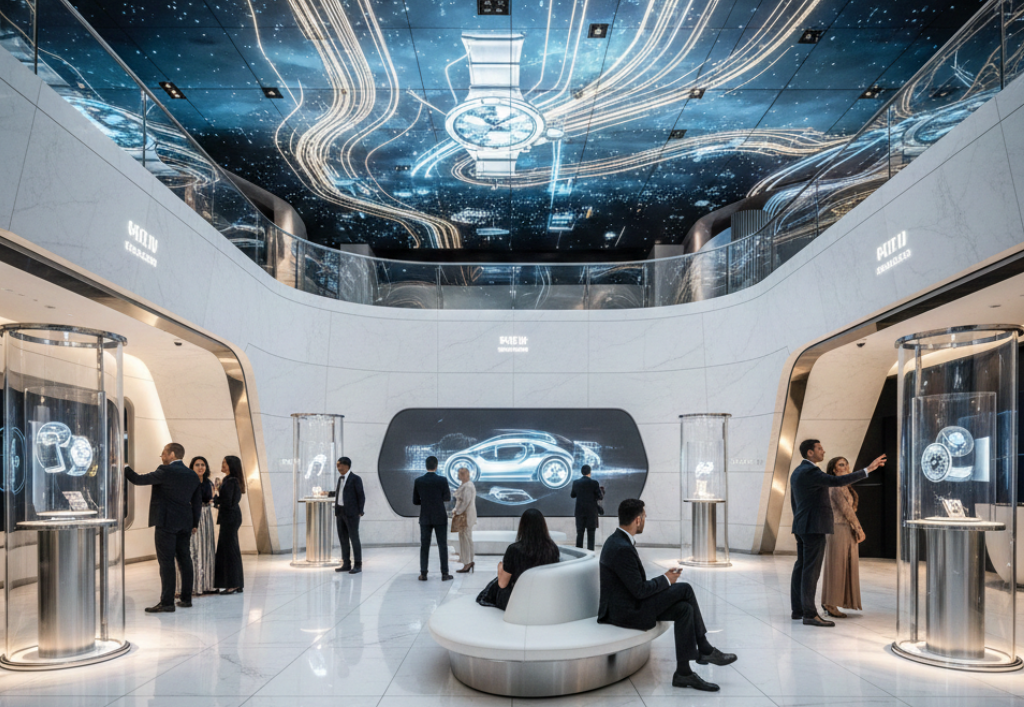
In a hyper-connected market where product quality and pricing converge, differentiation now lives in how a brand feels, not what it sells. Dubai’s malls, airports, and luxury districts thrive on this sensory differentiation. A coffee chain can serve the same beans as competitors—but how its light temperature, seating geometry, or ambient soundtrack affect dwell time defines conversion. Experience is no longer an accessory; it is a strategic moat.
2. Emotion at Scale
Emotions are the new performance metrics. Neuroscience has proven that 95% of purchase decisions occur subconsciously (Zaltman, Harvard). Modern brand environments in Dubai—whether a fashion flagship in Dubai Mall or a fintech lounge in DIFC—are engineered for emotion at scale. LED ceilings mimic circadian rhythms, scent diffusers trigger brand associations, and adaptive playlists shift energy during peak traffic. Emotion becomes design logic.
3. Omni-Channel Continuity
The post-2024 shopper oscillates seamlessly between digital and physical touchpoints. In Dubai, this translates to QR-to-AR trials, WhatsApp shopping assistants, and app-linked loyalty experiences that follow the user from screen to store to social. A shopper who saved an outfit on Instagram can “tap to locate” it in-store; their journey continues through NFC prompts and AI-powered fitting recommendations.
Agencies that master this choreography will define phygital continuity—the art of making every interaction frictionless and personalized.
4. Measurable Performance
Gone are the days when spatial ROI was anecdotal. With heat mapping, dwell-time sensors, queue analytics, and conversion dashboards, Dubai’s developers now demand quantifiable results. Brand environments are performance laboratories—measured by engagement, assisted conversion, UGC volume, and lifetime value uplift.
The smartest agencies build KPI frameworks before design begins, aligning aesthetics with analytics.
5. Cultural Relevance
Dubai’s cultural canvas is nuanced. The most successful environments are bilingual, bi-cultural, and time-sensitive—embracing the rhythm of Ramadan, National Day, and White/Yellow Friday shopping peaks. Aesthetic codes—calligraphy patterns, mashrabiya geometries, gold-neutral palettes—are used subtly to evoke belonging without cliché. Cultural fluency is now a strategic competency, not a decorative afterthought.
6. Sustainability Credibility
With Expo 2020’s legacy and Vision 2030’s sustainability imperatives, Dubai brands are under pressure to demonstrate authentic environmental responsibility. The new era of design specifies material passports, modular systems, energy-positive lighting, and recyclable displays. Circular design is not only ethical—it’s economical. Agencies integrating sustainability into storytelling (e.g., QR codes revealing a fixture’s carbon journey) will shape the new benchmark of transparent luxury.
The 7-Lens Brand Environment Framework (S7)
A practical, evaluative framework—built for 2025 briefings and procurement scoring.
| Lens | Core Focus | Application Example |
| Strategy | Clarity of brand role, audience states, and desired behaviors. | Define target emotions (trust, curiosity, aspiration) and behavioral KPIs (dwell, refer, subscribe). |
| Space | Planning, adjacencies, sightlines, and thresholds that guide decision-making. | Create “progressive revelation” layouts that reward exploration. |
| Senses | Visual, acoustic, haptic, olfactory, and thermal cues encoding emotion. | Use scent as brand memory; lighting to cue transitions. |
| Story | Narrative beats and micro-moments—arrival, discovery, trial, advocacy. | Turn checkout into an “earned stage” moment. |
| Systems | Digital enablement—POS, AR/VR, analytics, loyalty, RFID, data governance. | Use AI to personalize content by proximity and dwell time. |
| Social | Shareability, community programming, staff choreography, creator integrations. | Program “moment zones” for UGC and social amplification. |
| Sustainability | Material circularity, modularity, and energy performance. | Modular sets reused across retail cycles. |
How to Use S7:
Ask your agency to map every concept to these lenses, define 1–2 KPIs per lens, and show measurement and maintenance strategies. The best environments perform across all seven—not just look good.
Methodology for Selecting “Leading” Agencies
In 2025, awards are only one dimension. A more defensible evaluation framework includes:
- Sector Depth: Mastery in retail, hospitality, aviation, exhibitions, or corporate interiors.
- Strategy-Execution Integration: Ability to connect research, concept, prototyping, and rollout.
- Data Literacy: Sensor mapping, attribution modeling, and privacy-aware analytics.
- Cultural & Linguistic Fluency: Bilingual design systems, Arabic typography, and holiday-aligned campaigns.
- Sustainability & Accessibility: From LEED materials to WCAG-aligned digital kiosks.
- Governance & Scalability: Toolkits and operating playbooks enabling regional rollouts.
This model ensures selection based on systemic capability, not merely aesthetics.
Looking Ahead: The Future of Brand Environments in Dubai
By 2026, the evolution of Dubai’s brand environments will be defined by three convergence trends:
- Spatial Intelligence:
AI and sensor data will feed continuous improvement loops. Stores will learn—adjusting layout, light, and media based on behavioral response. - Metaverse-to-Real Continuity:
Virtual environments will act as prototypes for physical builds. “Digital twins” will enable test-marketing of experiences before real-world investment. - Purposeful Sustainability:
Dubai’s new building codes and brand mandates will prioritize modularity and circularity—every element designed for reuse, resale, or reactivation.
In this landscape, the most valuable agencies won’t just build spaces—they’ll build behavioral systems, blending psychology, technology, and aesthetics into measurable influence.
Conclusion: Designing for Emotion, Data & Meaning
In 2025, brand environments are strategic infrastructure—the physical extension of marketing intelligence.
Dubai’s best agencies understand that brand performance is no longer a campaign metric but a spatial outcome.
The CMO of the future will not brief for “design,” but for emotional precision, experiential ROI, and cultural fluency.
And the agencies—like Octopus—that can translate cognitive science into physical experience will lead the next frontier of Dubai’s creative economy.
 By, Shreefa Junaith
 - October 15, 2025
- 190
- Marketing & Advertising
- 0 comment
 Chat for Paid Ads